Showing posts with label Astronomical League Bright Nebula List. Show all posts

Wednesday, July 22, 2015

Three More for the ALBN and What was Lost is Now Found

LBN 140 was something I unsuccessfully tried to image from my red zone back yard using Ha. At NSP I gave it a try because the last night it was sitting in an area that still had good transparency. The first luminance frame showed some hints of nebulosity, so I continued on and collected more.

LBN 140
Getting this was a real bonus as it has a brightness of 6 on Lynds scale. A big thank you to the dark sky of NSP!

Two objects that I tried to image at the 2015 Nebraska Star Party didn't come out thanks to a really annoying line of clouds that slowly slid over them. Luckily, the one clear night at Jeffers allowed me to go after them again. These were IC 4812 and NGC 6729, luminous parts of a larger patch of nebulosity:

IC 4812 and NGC 6729
This would have been better in the AT65, but I decided to stay with the 200mm lens.

With these two I end up at 103, three more than needed.

Still to be processed is a 200mm field LRGB image of the Lagoon/Trifid area.


Now for something strange. At NSP 2014 I lost my mount's counterweight shaft end bolt, the thing that keeps counterweights from accidentally sliding off and crushing your foot. You know, this thing:

The lost bolt, now found

The bolt can easily be replaced by a bolt and washer (google and you'll see a lot of images of replacements), but it has the same specs as the bolt on my old CG5 mount, so I used that one as a replacement. However, knowing that I'd be going back to NSP again this year I began to entertain a notion that I might find my lost bolt. I know, NSP is a big place in which to find such a small thing, they don't mow the observing fields all that short, and there's been a year for it to get trampled, corroded, covered with dirt, or otherwise abused and knocked around. A bird might have decided to carry off the shiny thing. Realistically, chances of finding it were slim.

Maybe it was the small chance of finding the bolt that compelled me to look for it. Or maybe I just really hate losing things. So I set up camp as close to where I was last year as I could remember, put up my tent and set out my mount and observing table in the same relative positions. Of course I immediately searched the area under the mount and table with great expectation. Okay, that was unrealistic.

I began a not very methodical search extending outward from the mount and within a minute saw the bolt gleaming up at me, oriented as in the above picture, shining like a tiny mirror reflecting sunlight. It was only about ten feet away from this year's placement of the mount.

Had it been cloudy or I had been farther off in my positioning I might not have seen it.

As you can see in the image above, it picked up a little rust on the threads during its year of idle time in the wilds of Nebraska. Otherwise it's fine.

This year--so far as I know--I left nothing behind at NSP. But I think I'll go back again next year anyway.


Monday, July 20, 2015

AL Bright Nebula Observing Program DONE!

Finally! I've now imaged 100 of the "Bright" nebula objects.

There were only a handful of hours with clear (if not very transparent) skies at this year's Nebraska Star Party, but it was all I needed. I shot groups of objects in Scorpius and Sagittarius/Serpens to collect the six objects I needed.

Here's the first group, NGC 6357 (the Lobster), Sh 2-12, and Sh 2-13.


And here's the second group, IC 4701, LBN 53, and LBN 70

Still to process are a possible three objects, one from NSP and the other two from Jeffers Petroglyphs. The total integration time to reach 100 objects was 180.6 hours. That's a bit over 7.5 DAYS of exposure time!

Sunday, May 31, 2015

LBN 20 and 22, Neewer Digital Timer Remote First Look

Last night was a nice one. Cool, breezy, dry, no mosquitoes, and best of all clear. Okay, there was that almost-full moon, but the narrowband Ha filter dealt with it just fine.

LBN 22 (left half of nebulosity) and LBN 20 (right half)
These are my #93 and #94 of 100 on the ALBN. Two clear nights at the Nebraska Star Party and I'll be done. Maybe sooner if I pick up a few during the June new moon.

My Honis-modified Canon T2i will be delivered in two days. My plan is to use it for imaging at NSP while I'm also imaging with the SBIG CCD. This means bringing down my CG5 mount and running it off one battery. The camera will run off its own batteries (I have three). Rather than try to control it using the laptop, I've purchased a corded remote control. Which brings me to:

Neewer Digital Timer Remote First Look

In the past I've used a simple corded shutter control while DSLR imaging. This required me to keep track of the elapsed time. If I'm doing other things that kind of distraction isn't good; a programmable control would be much better. The Neewer is one of many models that allows you to set up an image-taking program. It gets very good reviews on Amazon, is priced under $20, and resembles a slender TV or DVD player remote. You can pay more--two or three times as much if you want to go with a name brand--but I don't see much point in that. The Neewer does what I want.

Now to some specifics:

Features:
  • A manual shutter button with lock
  • Programmable initial delay (the time between when you start the program and the shutter first opens
  • Programmable exposure time (zero to 99:59:59 with one second resolution)
  • Programmable time between exposures (same limits as exposure time). This is good for letting the camera cool between shots, or for time lapse imaging
  • Programmable number of exposures --select an exposure count of 1 to 399 images or continued imaging until manually stopped (or the battery dies). Neewer says the batteries will last two months shooting 5s exposures alternating with 5s delays. The control does not have an automatic power-off, but it's easy to turn off the three settings that could consume power.
  • The LCD shows the exposure progress, number of exposures, and counts down time while in delays
  • An LED changes color according to whether the program is shutter is open or closed. It's not bright enough to bother anyone
  • A soft beep that marks the seconds during exposures (it can be disabled)
  • A backlight button that turns on a dim backlight for the display.
  • A lock button that allows you to lock all functionality except the shutter release.
As delivered, you get the control and an instruction pamphlet. The instructions are well written and clear. My Neewer came with only English instructions.

My Neewer came in a flimsy cardboard box and plastic sleeve. The plastic cover of the LCD had a couple of light scuff marks that won't affect performance and don't bother me in the least. Buttons on the remote are clearly labeled and the case has a hole for attaching a strap (no strap is included) It was otherwise unmarked and seems to work just as advertised. Neewer says the remote will work between -20° and +50° C (-4° to 122° F), limits I can live with! I'll know more when I get my camera back and can test it.


Friday, May 22, 2015

Five LBNs in one image

Last night everything worked correctly and I managed to image the cluster of LBNs in Serpens that includes LBN 8, 10, 11, 19, and 1122.

Here's the image:


These are NOT very bright. Only 1122 rises to the level of LBN brightness 4; 11 is brightness 5, and 8, 10, and 19 are all brightness 6. Which is to say that these are really quite dim. Despite 170m of luminance shot at f/4 aggressive stretching is needed to pick out the nebulae. Regardless of that, I consider these good enough to satisfy the Astronomical League.

These five lift my count to 92. Where will the final eight come from?

The remaining objects [and their brightnesses] within reach are clustered.

Cluster 1 Sh 2-12 [4], Sh 2-13 [?], and NGC 6357 [?]. These three fit into a 200mm lens field. Image during July.

Cluster 1: Sh 2-12, Sh 2-13, and NGC 6357 (Lobster)

Cluster 2 LBN 20 [4] and LBN 22 [5]. The AT65's field is perfect for this pair. Image during June or July.

Cluster 2: LBN 20 and LBN 22
(Cluster 3) LBN 70 [6], IC 4701 [4], and LBN 52 [2] fit into a 135mm lens field. LBN 70 is huge; it encloses the Eagle Nebula and LBN 68. July or August.

Cluster 3: LBN 70, IC 4701, and LBN 52
(Cluster 4) IC4812 [?] and NGC 6729 [?]. This pair also fits nicely into the AT65 FOV, although the TV-102 might be better. July.

Cluster 4: IC 4812 and NGC 6729
The four clusters contain ten objects, putting me two over the required 100. There are a couple of very dim objects that remain for August and September in the event that these fail, and if those fail it's back to winter imaging!


Sunday, April 19, 2015

Two Rivers Spring Star Party: Image Planning

Sometimes planning seems like an exercise in futility, but it can be helpful when preparing to image far from home.

My first 2015 star party trip is to the Two Rivers Spring Star Party at the May new moon. This is located a little north of Barry, IL on a private farm. There's no power except for recharging batteries, so I'll be running from my big batteries all three nights.

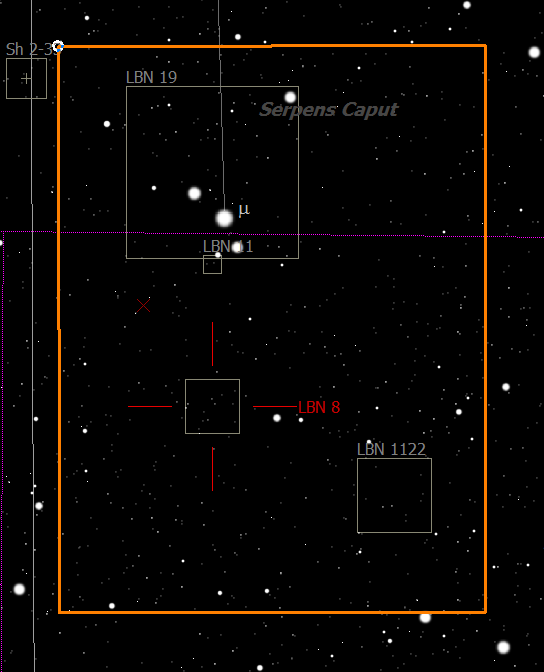
What's to image? There's a cluster of five ALBN objects to go after. Fitting neatly into a 135mm field are LBNs 8, 10, 11, 19, and 1122. All are emission nebulae. 1122 is a brightness four, 11 a five, and the rest sixes. This is an all-night group, complete with a meridian flip around 2 A.M. if the four hours from 10 to 2 aren't adequate. This should make a nice LRGB image!

LBN 10 is located at the red "X" NE of LBN 8and is about the same size as LBN 1122
Assuming there's a second clear night, I'll go after something not possible from Minnesota. LBN 1091 transits at 12:49 at an altitude of almost 16 degrees. This has an LBN brightness of 6, so it's going to be difficult if not impossible.

The rest of the ALBN objects I have to do are better imaged later in the summer. If there's a third night of clear sky I'll do a pretty picture. Maybe an LRGB of the Antares area at 135mm. What're the chances of that?

Saturday, April 11, 2015

Leo I First Attempt; LBN 1089?

Last night was clear and I tried imaging LBN 1089 and 1090 from the club's dark sky site Cherry Grove. It did not go well.

LBN 1089 rises to an elevation of only about 16 degrees; LBN 1090 maxes out at 13 degrees. There's simply too much extinction and horizon glow for it to show up. A total luminance exposure of 21 x 5 m at f/4 produced not a hint of nebulosity.

This shouldn't be surprising, I suppose. Dan Crowson created this image of 1089 and had this to say about it:

Lynds Bright Nebula 1089 is a very faint cloud of dust located in southern constellation Antlia. This object at -29 declination only reaches about 20 degrees in altitude from my imaging location. Lynds’ gives this one a 5 out of 6 on the brightness scale (with 6 being the dimmest). This is by far the faintest object I’ve tried to image so far. I had to stretch the data more than normal to get this result. This is another one of the ‘bright nebula’ that are found on the Astronomy League’s Bright Nebula Program. I could not find any other images of this one.
 

I've added the emphasis. When Crowson says something is very dim, it's dim. In fact if you look at the image the nebula looks more like an integrated flux nebula than any sort of "bright" nebula. Yet it's on the ALBN and supposedly can be visually observed.

I think an open question is why this nebula is on the ALBN list. The same issue applies to many of the other nebulae with Lynds brightness 5 or 6.


The magnetic finder worked great. There could be a little more friction between the base of the magnet and the steel plate, or possible some sort of detent to keep the finder from moving when turning it on and off.


At the end of the evening I tried imaging dwarf galaxy Leo I. It's brighter than I thought-- it was distinct on individual 5m, f/4 light frames. Tonight I'll try it again with my C925. It should look a lot better at a focal length of 1480mm than it did at 135mm!

Leo I at 135mm FL (5x5m at f/4)

As above from SkyTools3

Also on tonight's agenda is dwarf planet Orcus. Currently at magnitude 19.1 it's quite faint but should be in reach if my experience with MakeMake is repeated. In  that image I could see down to 19.4.


Wednesday, April 8, 2015

Astronomical League Bright Nebula Project List Update

I've gone through the entire ALBN object list and updated the coordinates to those provided by SIMBAD*.

In general the coords provided by the AL were close to a match (given the corrections noted at the bottom of the document). For some reason most of the AL Coords differed slightly from SIMBAD by one or two tenths of minutes of RA and DEC or more. A couple were off by half a degree of DEC.

For most people these differences are of no importance--they are using software to locate the objects by name. If you're doing that, you should be aware that some software may be in error. For example, SkyTools3 (which I use) has incorrect positions for LBN 1088 and LBN 10.

The new version of the ALBN is here.


* Coordinates are J2000. The coords for Pickering's Wisp were taken from SkyTools 3.


The SkyTools LBN 1088 error has forced me to change my imaging plans a little. Instead of being at a DEC of +31° the object is at -31°! It's actually just a little west of the LBN 1088/1099 area, so there isn't much time to image it from my northern latitude. Friday night is forecast to be clear, but there won't be time to do 1089/1090 and 1088 for several of hours each. Instead I'm going to go for quick and dirty: An hour each at  f/4, binned 2x2.


Friday, March 27, 2015

Olympus 200mm Lens for Astrophotography

If you'd like to do some wide-field astronomy with a SLR lens and don't have a DSLR, it's possible to mount the lens on your CCD. The particulars of mounting vary from camera to camera. Some of the adapters can be relatively expensive, but adequate lenses are well within the reach of the low-budget imager.

In my case I have an SBIG ST-8300M camera with a filter wheel. SBIG sells a Canon lens adapter for about $300 that mounts on the filter wheel (a spacer is needed if you don't have the wheel). This opens up the possibility of imaging with any other lens that can be used with canon EOS cameras.One such lens is the Olympus OM lens type. An adapter is needed to mate an OM lens with the SBIG canon adapter. (Yes, two adapters are needed between the lens and filter wheel.)

I've already imaged with an old 135mm Tamron lens that lived its previous life on my OM-1 SLR. Given the good images that lens produced I shopped around for a fixed 200mm lens.

What I found was a used Olympus AUTO-T E-Zuiko f/4 200mm lens at a local camera shop. These sell on eBay for about $50.

Olympus E-Zuiko AUTO-T 200mm f/4.0 with lens shade retracted. Image by Jone Quinn

Technical information about this lens can be found here. Why 200mm? It plugs a focal length hole between my 135mm lens and AT65 (422mm). Yes, I'm actually buying telescopes and lenses partly on the basis of their fit to a trend line. See how neatly the 200mm fits in in the chart below?

Everyone uses a semi-log chart for choosing imaging telescopes, right?

This lens is semi-automatic; it is wide open until the shutter opens and the camera tells it to stop down. There's no way to handle this with the CCD, so I inserted a plastic wedge into the lens base to keep the iris stopped down to the dial setting.

Last night I took a few images just to see how it well it would serve for astrophotography. My concerns were if it could focus infinity properly (which isn't a given thanks to those adapters) and how far itwould need to be stopped down to get reasonable stars across the field.

It reaches focus if you put the "3" of the 30m mark over the left index line for f/16. In other words, infinite focus is at about 35m.

And field flatness? It's very good for a $50 price point. Here's a full-frame bias-calibrated and stretched luminance images from last night, first at f/5.6:

f 5.6

and next at f/4 (same exposure and processing):

f/4

Vignetting can be handled with flat frames, and the stars are decent at f/5.6, a little less so at f/4 (although some of this is probably star bloat from processing). This shouldn't be a surprise as this is a fixed focal length lens designed to illuminate 35mm format cameras. The KAF-8300 sensor size is about half that, so it avoids the worst of the off-axis distortions.


For ALBN imaging f/4 is perfectly adequate. For "pretty pictures" I'll probably used f/5.6.

When used with the ST-8300, the 200mm lens gives a 3.9 x 5.1 degree FOV, a nice size for some remaining ALBN objects, either singly or in combination. (My last post lists my planned targets for this lens.)

Thursday, March 26, 2015

Map To 100 ALBNs

It's time to plan out the rest of the imaging needed to complete the ALBN. At this point it's looking quite likely that I'll be able to finish my 100 objects this year, thanks mainly to March cooperating and allowing eight objects to be completed.

The table below suggests there are 19 reasonably accessible objects to be had between now and September. Thanks to using short focal lengths they can be all be captured in 13 images. The two camera lenses will acount for nine objects in five images, with the remainder split between the AT65 and TV102.

If I finish or be close to it by mid-July I'll be free to use a possible trip to the Nebraska Star Party for creating pretty LRGB images instead of going after one of the faint ALBNs.

April (4 / 91)
Object LBN
brightness
Imager
LBN 1088
5
200mm
LBN 1089
LBN 1090
5
5
135mm
Sh 2-210
5
TV102
May-June (9 / 100)
Object LBN
brightness
Imager
LBN 11
LBN 10
LBN 8
LBN 1122
5
6
6
4
135mm
Sh 2-13
Sh 2-12
4?
4
200mm
NGC 6357
4?
AT65 or TV102
LBN 20
LBN 22
4
5
TV102 or AT65
June-July (5 / 105)
Object LBN
brightness
Imager
LBN 70
6
200mm
IC 4701
LBN 52
4
2
AT65
IC 4812
NGC 6729
?
?
AT65
August-September (2 / 107)
Object LBN
brightness
Imager
LBN 140
6
AT65
LBN 434
6
AT65

We've finally gotten some snow and the ground is again white. This means that Cherry Grove is not really suitable for use for a while. The snow needs to melt and the field needs some time to dry; it will probably be ready again around Easter. Until then I'll be working from my back yard and will be limited to narrowband.

Tonight is forecast to be clear, so I'll be able to test the 200mm at long last.

If you have the feeling I want to be done with the ALBN, you are correct.

EDIT: Looking for a backyard target on 3/29 I discovered that SkyTools3 has incorrect coordinates for LBN 10. This object is actually part of the LBN 8/11/1122 area. All four objects are a slightly better fit in the 135mm field oriented N-S, so I've changed the table to show this. I'm going to check the coordinates of all the table's objects against the SIMBAD database.

Sunday, March 22, 2015

Messier Marathon Night

The MM was something of a bust this year. Instead of bitter wind chills or an observing field buried under a foot of snow, conditions were actually quite pleasant. But there were those clouds. Patches of opaque clouds gave way shortly after nightfall to a succession of semitransparent bands that simply wouldn't stop obscuring large chunks of the sky. For the most part I could shoot through the clouds, but visual observers were shut out of all but open clusters and the brightest nebulae and galaxies. 

Seeing was suggested to be poor, too. And then there was the wind. Southerly and modest at first, as a cold front passes they turned and gusted to almost 30 miles per hour. My autoguider struggled but held its own against this for the most part--a few frames had to be dropped because of poor tracking. 

I started the evening with thoughts of doing some MM work myself, but conditions ended that possibility. Instead I concentrated on imaging the brighter winter objects of the ALBN. 

The updated winter list (earlier images in green, MM night objects in red):

January: IC 2169, LBN 943, Sh 2-280, NGC 2296, IC 468, NGC 2359
February:
November: IC 360, NGC 1555, NGC 1579
December: LBN 945, NGC 1931, Sh 2-264, NGC 1999, Sh 2-240, LBN 962, NGC 2149, NGC 2174, IC 2162


This is the end of any chance to get more winter objects unless the skies clear quickly. Still, this winter netted eleven objects, leaving me at an ALBN list count of 87 done, 13 to go. Next up are some large LBNs that will test my still unused 200mm Olympus lens. LBN 1088 (200mm); a combo shot of LBN 1089 and 1090 (135mm), then another 200mm combo of LBNs 89 and 90.

From MM night, all taken using a TV-102, ST-8300M camera shooting luminance frames:

A combo image, the Cone and Hubble's Variable Nebula--
Cone and Hubble's Variable Nebulae


The effect of clouds is evident around 15 Mon (the bright star at top of image). Despite that the cone and Hubble are evident. Next is the Monkey Head--

NGC 2174 (Monkey Head)
Can't see the "Monkey?" It's more evident when shown south-upward instead of north-up as in this image. Some clouds here, too; the glow around 68 Ori (at lower left) is theirs.

Last, NGC 1931 (which is nameless, so far as I know)--

NGC 1931
Still some cloud effects. This deserved a longer focal length, but I wasn't about to swap telescopes at midnight at a remote site. An eventual overcast forced me to stop this sooner than I wanted.

I packed up and left the field at 1:23. I was the last to leave, which tells you what sort of MM it was. A nice get-together, a good no-pressure night for some of the club's beginners, some so-so imaging, and a spectacular fireball that lit up the sky. All of which were better than a -25F wind chill.


Wednesday, March 11, 2015

Three Months Later: Winter Imaging

At the end of November I listed the targets that might get me to the goal of 100 ALBN images. These were mainly the brightest objects that remained on the list. Quite a few were during the winter months, and I despaired that a bad winter would prolong this project. In the winter of 2013-2014 I did no imaging at all. I really needed to get at least seven objects off the list or face another winter of ALBN imaging. So how did things turn out?

Here's the list I drew up, with newly acquired objects in bold green:

January: IC 2169, LBN 943, Sh 2-280, NGC 2296, IC 468, NGC 2359
February:
November: IC 360, NGC 1555, NGC 1579
December: LBN 945, NGC 1931, Sh 2-264, NGC 1999, Sh 2-240, LBN 962, NGC 2149, NGC 2174, IC 2162

Sometimes all it takes is a good night once in a while. One night in January produced three objects (LBN 962, NGC 1999, Sh 2-240); a night in February gave Sh 2-264, and this week a couple of nights have given NGC 2359, IC 468, and IC 2162. Add one more object that was found on an existing image of the Rosette Nebula. That's eight winter objects. (Updated 3/14: IC 2169 makes it nine.)


There's something of a gap now between the fading objects in the winter Milky Way and those of the summer. If I can get a couple of clear nights between now and the first quarter moon I can probably pick up a few more before they're lost to the brightness of dusk.

Next time: Imaging a dwarf planet!

Wednesday, March 4, 2015

Global Warming

No, I'm not putting that title on this entry just to garner some hits. I'm writing this because of a fine interview article that appeared today in a local online news source, MinnPost. The interview was with Paul Douglas, a nationally known entrepreneur, weather expert, broadcast meteorologist--and conservative.

For years I taught an intro meteorology class at a local college, and my message to the students was always much the same as Douglas's: AGW is real and represents both challenges and rewards to those savvy enough to help society cope with the coming changes. Both sides of the political debate have stepped away from reality; some conservatives continue to deny and denigrate the science, while some liberals refuse to accept possible solutions.

Both sides strut their ignorance (feigned or real) by using weather events to deny or confirm their beliefs. For some trolls every cold snap is an opportunity to scoff at the reality of AGW, while for others every heat wave or drought is an excuse to trumpet what they see as the impending "heat death" of the planet.

The reality is both simpler and more complex at the same time.

In the no-brainer category: Significant atmospheric warming, sea level rise, and oceanic PH change are all happening now. Very likely on the way are shifts in local climate causing changes in rainfall, growing seasons, and availability of water. Things that are not so clear: Stronger storms, hurricanes, droughts, floods, heat waves. A great deal of work remains to be done to understand some of the side effects of AGW.

Back in the mid 1990's I told my classes that AGW wouldn't be accepted by the American public until around 2030. The current dysfunctional political climate leads me to think that statement remains about right.

I have no ax to grind on this issue. I no longer teach, so I'm not under any pressure to promote the company line. (I never was, actually.) I have no children or grandchildren who may be impacted by AGW. My days of chasing atmospheric science research funding from the National Science Foundation and NASA are far in the past. I don't sell educational, weather-related software any more, so I have no customers to keep happy.


Back to the usual stuff: Astronomy! Tonight looks like it might be the last below-zero night of the winter. After this the forecast is for a run of days warming to almost 50 next week! What little snow we have on the ground (and it's not much) will disappear in the next 10 days, well in advance of the Messier Marathon. With a little luck (and I've used that phrase too many times lately) I may be able to pick up some straggler winter Bright Nebulae images. If that happens I have a real chance of completing the 100 this year (I'm currently at 79). Last time I mentioned a good night was about to happen. It did, and I got #79:
Sh 2-264
This is the big Sharpless object at the head of Orion. I only got two hours of Ha under red zone + first quarter moon skies, so it's kind of ratty. I love the big field of the 135mm Tamron lens, almost 5.7 by 7.6 degrees in this image!


I'm now working on a gradient removal program that makes use of some of the meteorological code I created for some of the educational software mentioned above. (In some ways vignetting and light pollution gradients resemble atmospheric pressure fields.) This program is still in its infancy, so there's nothing to show at this point.

Friday, February 13, 2015

Some odds and ends for a Friday the 13th...

AL Bright Nebula Imaging Planning
I took some time to plan my imaging for March and the Messier Marathon night. The tentative lineup, all to be imaged using the AT65EDQ, includes four objects. The Cone Nebula (NGC 2264) and Hubble's Variable Nebula (NGC 2261) in a single frame. Both of these are Lynds brightness 1 objects and available from the onset of darkness until about midnight (3 hours or so) meaning I can probably do a nice LRGB of them. After that it's on to LBN 10, high enough for imaging until about 3 A.M., and  then LBN 1122, good from then until dawn about 2 1/2 hours. LBN 10 is a brightness 6, so it may only be L; 1122 is a 4, so maybe that will get the LRGB treatment. Dan Crowson's scheme is usually 12x600s for L and 8x300s binned 2x2 for each color channel, giving a total exposure time of four hours. I'll probably go with a much shorter plan; 12x300 L and 8x180 RGB (132 minutes) for the two bright nebulae; 20x300L and 8x180 RGB binned 2x2 for LBNs 10 and 1122.

If a miracle happens and we get some good weather in March, these plans could change to include more objects. Let's hope.

Good Luck
While planning the imaging around the Cone Nebula area I noticed that another AL Bright Nebula, LBN 943, was nearby. In fact, 943 is essentially a part of the Rosette Nebula, and it shows up in the image I had of the Rosette. I had overlooked this and failed to enter it in the "done" list. It's included now, pushing my total to 78. I wish they were all this easy!

NFeeder Progress
Not much in the last couple of days. I've designed the interface for setting up the camera, using the PHD command, and providing temperature control (including a programmed drop to the setpoint).

I've decided to split scripts into three pieces: general setup  before image capture; the imaging commands; follow-up commands (such as a slow warm up, disconnecting from the camera, and shutting down Nebulosity). I'm not sure if this is a good idea at this point.

The weather continues to misbehave
Cloudy and warm evenings punctuated by rare clear and cold nights. The long range forecast suggests no imaging for at least the next week, by which time February will be 3/4 past. Good riddance.


Sunday, February 8, 2015

Nebulosity Feeder continues development

My little project continues. A lot of changes have been made since last time, thanks to suggestions from a club member who tried it out.

For the most part, the changes are intended to make the program a little smarter about how it does things. The program keeps track of the last download image folder used and the last folder used to save or load a script. The default filter wheel information is now stored in the Windows Registry. (Non-default filter wheel sets can be saved as text files.)

Scripts now allow for external filter wheels. And thanks to a suggestion from the program tester the program now lets you know more about capture status: Which filter is being used, which frame is being captured, and about how much time the frame has remaining. Nebulosity does this, but only in small print on the status bar. Look just above the script:


The box showing the script now automatically scrolls to keep the current command in sight. The status even indicates when the latest image is being downloaded.

The Script Editor now looks like this:


A big change is that the duration and frames can be selected using drop-down lists (you can still enter other values manually.) 

Because it's possible to manually edit the created script (and thereby introduce errors), the script gets parsed and error-checked as it's sent to the Feeder screen.

Lastly, the Filterset Editor is now a part of the main program instead of being a pop-up dialog:


It's been simplified to emphasize working with the default set. On the left is something new: Preferences. There's only one setting at this point, but I've left room for more. A new object I call the Preference Manager is now running nicely and ready for more work. Preferences are stored in the Registry.

Speaking of the Registry, I've made sure that an uninstall of NFeeder removes everything it put into the Registry.

Still to come (if there's interest) are
  • Options for using a larger set of Nebulosity script commands.
  • Night vision ability, which I'm finding difficult because it will require using Qt's stylesheets.
  • Better help files.

Want to try it out? The Download is HERE


There was actually a nice night a little over a week ago and I managed to sneak in a couple of images using my 135mm Olympus lens. It captured three more images toward my AL Bright Nebula list!


The latest images were post-processed with the aid of Imagenomic's NoiseWare Professional Edition standalone noise reduction software. It's almost too inexpensive to not purchase. There's also a Photoshop plugin available at a higher price.

Sunday, November 30, 2014

Finishing the Astronomical League Bright Nebula list anytime soon? Not very likely.

The ALBN requires 100 objects to be imaged, and I'm in need of 26 more to finish. There are 62 listed objects that I can choose from according to the published list. Let's see how that shakes out.

First eliminate the bogus object on the list, IC 425, although I'm tempted to image its supposed location and count that as one. This leaves 61 Objects.

Next, eliminate all the objects that are too low to image from the locations I plan to use. The southernmost locations are the Iowa and Nebraska star parties at 41.8 and 42.6 degrees north, respectively. As a guess, these allow imaging to about 40 degrees south declination. This eliminates five objects: IC 4628, Gum 12, NGC 2736, NGC 6164, and NGC 6188. There are now 56 objects.

Now let's assume I want to avoid imaging objects that require very dark sites, namely those with Lynd's brightness 6. This includes eleven objects (Sh 2-218, LBN 619, 1064, 683, 8, 10, 1091, 19, 70, 140, and 434). There are now 45 objects available. (Tossing out the brightness 5 objects eliminates another 12 objects, leaving 33.)

Let's see how far I could get just doing the brightest objects. Brightness 1 has 4 objects, 2 has 4, 3 has 5, and 4 has 7. The total without dipping into the 5s is 20. There are some objects without assigned brightness that could add some to this: NGC 2174, Sh 2-264, LBN 962, NGC 2149, NGC 2296, NGC 6357, NGC 6729, and IC 4812. These lift the total to 28! Only two objects to spare!!

Actually, LBN 20 and 22 (brightness 5) share a field, so there are three to spare.

A first pass at the optimum months for imaging these can be found using SkyTools3.

January: IC 2169, LBN 943, Sh 2-280, NGC 2296, IC 468, NGC 2359
February:
March:
April:
May: LBN 1122
June: LBN 20, LBN 22, NGC 6357, Sh 2-12, Sh 2-13
July: IC 4812, NGC 6729, LBN 52, IC 4701
August:
September:
October:
November: IC 360, NGC 1555, NGC 1579
December: LBN 945, NGC 1931, Sh 2-264, NGC 1999, Sh 2-240, LBN 962, NGC 2149, NGC 2174, IC 2162

This is where the bad news rears its ugly head. Sixteen (nineteen minus the three spare) objects must be imaged during the winter months. Given the terribly cloudy (not to mention cold) winters we've had lately, this becomes problematic. It's probably going to be necessary to dip into the dimmer objects that are available in spring and summer. These include LBN 683, 1088, 10, 1091, 19, 11, 8, 70, and 490. That's only 9, though, which means that at least seven of those winter objects will need to be imaged.

Conclusion: I might be at this for a couple of years yet!

Tuesday, September 16, 2014

LBN 270 Mosaic

It's done. Spanning four nights (if you include one night's data that I eventually discarded because of poor focus), the four-image mosaic of LBN 270:
LBN 270
The irony of this is that I had to dodge a lot of clouds in order to image clouds. Only one night was clear for long enough that I was able to image two quadrants of the image.

Normally I would be imaging unbinned because of the short focal length used (an AT65EDQ at 422mm) and 5.4 micrometer pixels of the ST-9800M. Instead I did this by using 2x2 binning, which results in a speed gain by a factor of something like 3.6 (depending on who you trust as a reference). Each quadrant of the mosaic is based on about 20x300s light frames for a total time of about 6.6 hours.   

This is an object on the Astronomical League's Bright Nebula list. 

Speaking of which, a corrected list of objects that I made some time ago is now residing on the AL web site at:


I might complain to the AL about getting no credit for this, but so far as I can tell they don't publicize this document.

The "official" list, still with errors, continues to be linked to at

https://www.astroleague.org/files/u3/BrightNebulaRev2.pdf

When is the AL going to fix this list? It's been over a year since the original posting of the list.

But enough about the AL, and more about the mosaic. I actually have two images I could append to the mosaic, one for IC 1318 (butterfly) and DWB 111 (propeller). The former is not oriented well, so I'm thinking that in a year I might revisit this and extend the mosaic down to Sadr so that it includes all of IC 1318.

But for now it's back to the list, and seeing how much binning helps tackle some of the dimmer objects on the list.

Tuesday, September 9, 2014

Time for Mosaics

I imaged many of the smaller/brighter AL Bright Nebula list objects in this season's sky last year, so this year I'm left to clean up the more difficult objects. These can be more demanding in terms of the sky I have to work with (tree-locked and bright), or by virtue of their larger size. In the former category are reflection nebulae and Lynds brightness category 6 objects.

Here's an example of the former, IC 4954 in Vulpecula:


This was shot in H alpha because it has a weak emission in that, and the narrowband filter helped to reduce the light pollution and moonlight. This is given a 2 for brightness.

For faint there's DG 191, shown in the previous post. There's no official brightness for this, but I estimate it as a Lynds 4. Most of it is visible in weak Ha emission, but the lower right quarter or so has a substantial reflection nebula component. Because I wanted to catch the blue tint I shot this in RGB. I should have gone with HaRGB, but I wanted to complete this in one night.

Sh 2-134 was too large for a single frame at 400mm. I combined two images to create a minimal mosaic using Photoshop:


I used Photoshop's default settings for this and it turned out pretty well. There is a transition line visible along the top of the lower frame, so it could use some reprocessing.

Next up is the huge LBN 270 (3 degrees across) in Cygnus, which will require a 2x2 mosaic. I managed to get the southwest frame last night during a couple of hours of clear sky!

Eventually I'd like to patch together a mosaic of Sh 2-240 (Simeis 147 in Taurus), a large supernova remnant in Taurus. That might take five or six frames!

Saturday, November 23, 2013

Astronomical League Bright Nebula List

EDIT: 5/9/15: The lastest version of my corrected ALBN list can be found at THIS post.

Earlier this year the Astronomical League introduced the Bright Nebula Observing Program. As is traditional, this program provides a list of objects to be observed. In this case there is also the option to image objects. For the BN program visual observers are required to acquire 60 objects (non-observations are also accepted). Imagers must capture 100 objects.

The first version of the object list contained quite a few errors and has since been revised. Unfortunately the revised list still has a few errors and some points of confusion, particularly concerning some compound objects:
  • The Heart nebula is given as IC 1805 + IC 1795. NGC 896 is listed as a separate list item, but most references have it as identical to IC 1795. Why is there a distinction here?
  • The Flame nebula is listed as NGC 2024 + NGC 2023. Most references do not include 2023 in the flame, as they're quite distinct from each other
  • Sh 2-8 and NGC 6334 are considered to be the same object (the Cat's Paw nebula), but are listed as separate objects. Possibly the list intends Sh 2-8 to be the extended nebula surrounding NGC 6334, but that distinction is not noted
  • The Gamma Cygni nebula is also referred to as the Butterfly Nebula, which is IC 1318B and C. It's not clear if observations are meant to include IC 1318A
  • The Pelican nebula is generally considered to be made up of two objects, IC 5070 and IC 5067. For some reason the list adds IC 5068 to the Pelican
Some errors give evidence of inadequate proofing:
  • LBN 8 is listed twice
  • The declination of NGC 2174 (Monkey Head nebula) is incorrect, probably because of a cut-and-paste error. It is given the same declination of the object just before it in the list
  • LBN 10 is the probable victim of a typo; its right ascension is off by five hours
  • IC 1287 is placed on the list out of right ascension order
And one error is just plain dumb:
  • IC 425 is on the list, but it is generally considered a fictional object. Another non-existent object was removed from the list's first version but this one persists. Maybe it's there as a test of observers' veracity?
Since it's my intention to do this list through imaging I've been taking a closer look at it. Because I find the published format (PDF) difficult to work with, I've converted it to a Microsoft Word document. As a part of this reformatting:
  • Objects that are also in the Lynds Catalog have had their catalog number and Lynds brightness added. The list fulfillment requirements include giving the Lynds brightness for each object
  • A list index has been added so that each object can be referred to by a sequential number. (For what it's worth, there are 154 real objects on the list. The list originally was said to have 160 objects; it didn't. It now is said to have "over 150," which is correct.)
  • The above-mentioned errors I've spotted have been corrected
Note that I have NOT done a quality check of all the data supplied by the AL--I've only tried to catch obvious errors. Nor have I tried to resolve the issue of multi-component objects, or to reorder the list. Omitted are the chart numbers.

Here is a link to my revised document. Feel free to download it. If you find errors in it, let me know and I'll correct them.

This can be easily converted to spreadsheet form, which I've done. I've also converted it into an observing list for Sky Tools 3.

Final comments: This is a difficult observing program, particularly because many of the objects are very dim. Northern observers will not be able to see many of the objects at all (at least 22 are invisible from my latitude of 45 north). I think that this program would have benefited from having several people examine and field test it before it was announced. Perhaps in time it will get cleaned up.

Working the list: As of today my tally is 47 list objects imaged with 53 remaining to do. After looking at the list it appears there are about 50 reasonably "doable" objects left for imaging, which will leave me three short. It's going to be interesting.