Sunday, March 19, 2023

A Wristwatch for Astronomy?

Let's take a short break from the Gandhi watch. It's currently being cranky--or at least its keyless works are. (Just so you know, the keyless works are the parts that enable the watch stem to wind the watch and adjust the time. They're nasty complicated and vary in design possibly more than any other part of old watches.) 

Today's question is: What do I really want out of a watch? And let me be specific, a watch that I would use, particularly during my summer hobby of astrophotography. 

I already have a quartz wristwatch and a cell phone. Both are great at giving me the time with wonderful accuracy. The phone is kind of clunky for that, though; the quartz watch is small and nice to look at during daylight but lacks the charm of a wrist-winding timepiece.

Mechanical watches of course have their own shortcomings. Accuracy isn't quartz-like; A modern hand-winder will probably have time errors of up to 10 seconds or so each day. I know, how horrible--in a week's time it may be off by a whole minute! You also won't get anything fancy like an electroluminescent display or Bluetooth compatibility, nor will it accept your calls or fetch email. 

What I want from a watch is readability at night and the ability to tell me when a certain time interval has passed. Accuracy is not terribly important because I want it to indicate approximately when an interval of only ten or twenty minutes has passed; an error of even a few seconds is acceptable. The timing error I mentioned above, 10 seconds per day, is equivalent to about 0.07 seconds per ten minutes. That's far better than I need!

I hit the wonderful age of 70 this summer (chocolate cake is preferred if you absolutely must get one) and my eyes are not what they used to be. I have some difficulty with visual acuity when using monochrome red light. So a big watch face with large numerals is a plus. And those numerals should have good contrast with the dial face. The same applies to the hour and minute hands. 

Chance and the cyclic nature of fads have combined to stage a rebirth of large watch movements with equally large faces. There are a wide variety of designer watch faces for these, so it's easy to find a face with large, luminous numbers. For the same reason wide luminous hands are readily available.

You may be wondering why I care so little about accuracy. Most astrophotography is highly automated now even for those of us who haul our gear to remote sites. Best Practice is to sit and watch over it, much like keeping your hands on the steering wheel of a Tesla in Autopilot mode because you just never know when it's going to do something bad. And if you image, you know something bad will happen because it always does. Granted, not driving off the road bad, but bad enough. So you want to be there when it happens, ready to jump in and start mashing keys and flinging the mouse cursor around in a mad attempt to get it all running again.

The reality is that this "Best Practice" stuff is not Fun. Actually, it's more like mind-numbing. There are other things to do that at least resemble fun, if fun can be had sitting around in the dark at 2 A.M. Allow me to suggest alternatives to Best Practice...

Usually there are other imagers around who you can talk to, even if it's only an excuse to eyeball their gear and incoming light frames of some obscure NGC object. You can tell them you also imaged NGC-whatever years ago and while their image will probably be "nice," it will look "better" after 40 or so hours of intense processing with whatever expensive software you use and they don't have.

Also, god forbid, there may be some visual people around looking at stuff with their eyes. You might grow nostalgic for your pre-imaging days when all galaxies were fuzzy little balls of lint barely brighter than the background sky. You might even be moved to ask for a peek at what they've got in the eyepiece. They will, of course, oblige, since it gives them the opportunity to comment on how they once considered imaging but decided it was too much work (true) and that wow, your laptop is kind of bright (not true, but that's visual people for you). At which point you are free to amble off and bother someone else.

It's also possible some of the non-imaging, non-observing public is wandering around. Because you're experienced you know how to say "Sorry, I'm Imaging" with a tone of voice both condescending and full of menace. By those three simple words you'll convey to them that they can't possibly understand what you're doing and that if they touch your very expensive imaging rig it's likely you'll have to hurt them badly. Remember that in the the dark they can't see what you look like, so try to sound like you're six foot eleven and can bench press their entire family. This almost always convinces them they are free to amble off and bother someone else. If they fail to take the hint you should simply direct them to the visual people who earlier slandered your laptop.

But you can't just wander away from your imaging gear for hours of Fun unless you want hours of worthless data. You need to make periodic glances back at all that technological stuff to see if it's still working. I usually do this every ten or so minutes, so that's what the watch tells me. I suppose I could have a timer that dings when ten minutes have passed, but that would be annoying and deprive me of the chance to flash my oversized, easy to read watch for all to see and admire.

OK now, let's look at this admirable watch. It's not the same exact one I made as part of the watchmaking class I attended, but it's close. The background color on the face of mine is a darker blue; like this one it has nice big luminous numbers and hands. (The face diameter is almost 40mm, compared to the 30mm of my quartz wrist watch.) Under red light the face appears black and the contrast is superb.

There's even a second hand should I ever need to time something with a little precision. 

Note that this is a wrist watch style case. If you prefer a pocket watch to one that sits on your wrist it's possible to wrap the movement in something called a Hunter case. This provides protection for the crystal if you want to keep other things in your pocket like coins, keys, hex wrenches, bottle openers, etc.

Hunter Case 

Open Face Case


Hunter cases usually have at least two hinged covers (front and back); notice that the stem is at the 3 o'clock position. The open face case has one hinged cover on the back to protect the movement and the stem is at 12 o'clock. (Bonus factoid: o'clock is short for "of the clock.")

Hunter cases are usually opened by slightly depressing a button on the end of the stem. And unlike how every old movie shows someone closing a hunter-style pocket watch with a loud snap that is not how it's done. You should press the little button again, close the case, and release the button. Snapping it shut causes the cover latch to wear quickly; too soon you've got a case that won't stay closed.

My preference is for the open face version--it's easy to use! Ease of use is important when it's 2 A.M. and you're feeling a little tired, believe me.The wrist watch form is easy, too, but those are designed for right-handed people. If you're a "righty" and doubt that, try doing what a "lefty" does. Wear your watch on your right arm and try to wind it (or adjust the time) using your left hand. See?

Friday, March 10, 2023

Gandhi Watch continued

 Disassembling the watch revealed a couple of surprises given the watch had been "refurbished."

The basic procedure for servicing a watch is three steps: disassembly/inspection, cleaning, and reassembly/oiling. The service this watch received failed on at least two of these steps.

The most glaring problem was broken teeth on the ratchet wheel, seen in this image:

The HMT mechanical hand-wind movement is based on the Citizen 0201 design, and Citizen is said to have overseen manufacture to insure high quality. It looks like that quality control may have relaxed, given that this wheel looks as if it is stamped steel that's been thinly plated. I was able to replace this wheel using another identical movement. (This wheel mainly interacts with the click to prevent the mainspring from unwinding, so its proper function is essential.)

The refurbishment was certainly sloppy. Look at the wild amount of oil pooled under the keyless works:

There's another anomaly I noticed in the first HMT I practiced on that is repeated with the Gandhi watch. The sweep second wheel passes across the barrel bridge, and it looks as if there has been an attempt to slightly deform the bridge at the point the wheel enters over the bridge, possibly to provide greater clearance between the wheel and bridge. I have a few more HMTs and it will be interesting to see if this deformation appears in them as well.

The technician who did the refurb either missed or didn't care about the missing teeth, and really pumped in the oil. The watch does run, though, so the basic requirement is satisfied.

I've done the disassembly and reassembly without incident, but my cleaning was not adequate to remove the really baked-on gunk. Soaking in naphtha and scrubbing with  stiff nylon brush got some but not all the parts clean. I think I'm going to disassemble it again and run it through the ultrasonic cleaner, then oil and reassemble. 

--------------------------

I had been hoping to attend a meeting of the Midwest Watch Club's Spring Meeting, but it was moved from March to late April. The problem that continues to be central to this hobby is the direction to go with it. Collecting watches? If that's it, should it be wristwatches or pocket watches? And should they be antique, vintage, or contemporary? Or should I take brand new modern movements and ready them for sale? 

Or make a hobby of restoring old watches to working order? This is an expensive option since it requires the purchase of expensive tools like mainspring winders, crystal fitters, and

It would be nice to get the perspectives of other watch enthusiasts.

--------------------------

I've also now completed a beginner course in watch servicing offered by a local watch shop. We took a new 6497 clone movement through the three servicing steps mentioned above and put it into a case with straps. It's ready to wear and running great. It's amazing how much easier a modern movement is to work with than the designs of the early 20th Century! Except for the shockproof springs, I hate those! 😖

--------------------------

Next time, the Gandhi will be back, oiled and ready, with its results from another run on the timegrapher.

Friday, January 13, 2023

Assessing the Gandhi Watch

Last time I showed you a practice watch I'd obtained, a refurbished HMT movement-based wristwatch with a picture of Gandhi on the face. I alluded to something called a timegrapher that is used to assess a movement's wellness, and today it's time to see what it says about my new watch. 

If you're not familiar with how a watch movement works, the following is a very brief summary of what makes it tick.

A watch's mainspring is a coiled band of metal that is wound around a post and the tighter it's wound the more energy it contains. That energy tensions a series of reduction gears that end with what's called a pallet. The pallet rocks back and forth in unison with the oscillation of a spring-mounted wheel called the balance. With each oscillation the pallet pushes the balance a little and gives it a bit of energy. So: mainspring stores energy, the gears and pallet transfer energy, and the balance dissipates energy via friction as it oscillates.

The balance wheel is basically a torus of metal that oscillates around the axis through its center and perpendicular to the plane of the torus. It is designed to oscillate at an exact frequency (18000 beats per hour in the case of the Gandhi watch). This causes the energy to be released from the mainspring and the reduction gears to turn at a fixed rate, thereby driving the watch hands around the face.

Now that you completely understand how a watch works (ha ha) we can continue. 

A perfect watch keeps perfect time; it has a balance wheel that oscillates at a constant frequency regardless of how the watch is oriented. Of course, no watch is perfect. The goal of servicing a watch is to find the imperfections and try to minimize them. Toward that end there's a diagnostic device called the Timegrapher:

A timegrapher includes a stand (left) that holds the watch to be assessed. It has a very sensitive microphone in it so that it can hear the workings of the watch and send that information to the display unit (center). 

This morning I put the Gandhi watch on the stand (in the face-up orientation) and put my timegrapher to work. Here are the results and a little about what they say about the watch


This will need a little decoding, so number by number here's what it says.

  1. Daily time error. It's slow by about a minute a day, which is just okay. A few seconds per day would be better. 
  2. Balance amplitude. The balance is turning through 133 degrees, which is far too small. A healthy watch turns through well over 200 degrees.
  3. Beat Error. This is a measure of the asymmetry in how the balance is being fed energy. A decent beat error is under 1ms, so this is much too large. One consequence of this error is that the watch won't start running easily, and that's what I observed--it would not start until half wound. It also means the watch may perform quite differently in different orientations.
  4. Alternating display of lift angle and beats per minute.  For this watch the lift angle has been set to 52 degrees and the unit has detected that the watch should be operating in the 18000bph mode.
  5. The daily time error during the previous sampling period of 12 seconds. 
  6. The timegrapher provides a visual summary of items 1 and 3 with sloping lines. The greater the slope the larger the error, and the amount of beat error is indicated by parallel lines some distance apart. A watch with zero beat error would show only one line.

Next I put the watch stem-up on the microphone stand 

The watch is now only 19s slow per day, but not much else has changed. (7. happens to be showing the beat rate in this image.)

Two things stand out, the terrible amplitude and large beat error. As a first guess this watch needs a good cleaning and oiling to improve the amplitude. Disassembling the watch may reveal other problems.

Next time, the Gandhi watch in pieces.

And after that, creating a watch for astrophotography.


Thursday, January 12, 2023

Winter Watchmaking

 Yes, it's been sincerely winter here since I last posted. Overnight temperatures have cruised down to -11F and there's been a lot of snow. Not Buffalo NY amounts by any means--total seasonal snowfall is now at 48.3 inches which is about twice normal, and the snow depth is 13 inches. Everything has a thin crust of ice on it, too.

This means it's been time for my winter hobby to get going. I've been out and about trying to learn about how to get the basic raw materials: watches (including bare movements) and tools. I'm also starting to ponder how to make this a long-term sort of thing. 

Last year I mainly focused on dismantling old pocket watches; This year I'm going to get a formal, if brief, education by taking a two-day class from a local professional watchmaker. I'm also going to try my hand at smaller movements. Toward that end I've purchased several HMT watches from Ebay. These have India-made movements, are typically 17 jewels, and can be had for about $10 refurbished and running. At that price there's not a lot of concern about fumblefingers wrecking it. Here's a picture of the first arrival

Yes, that's an image of Gandhi on the face. The hour and minute hands are luminous, but I'm not sure about the choice of a red second hand over a red watch face. Oh well, it's the movement that has my interest, and here it is


Fairly clean looking, but there is some discoloration on the spacer ring near the stem suggesting there might be some rust. That might account for the gritty feeling when the crown is pulled out or pushed in. On the plus side it seems to be keeping good time. I'll be able to quantify that once I put it on my timegrapher.

Like most modern wristwatches this has a screw-on back, and normally one would use a special tool to open it. It's often possible to use a rubber ball instead. One simply presses the ball against the back and turns it. Here's the one I use

It's not the famous Bergeon #8008 8-ball ($17 on Amazon or $9 on Esslinger, shipping extra). It's a dog play toy ($5 from Petco and probably other pet supply stores). It has a smooth, tacky surface and seems to work quite well. It's not inflatable so no need for a pump. And as an extra bonus it squeaks!

A footnote about saving money: shop Ebay, not Etsy. I paid $7.50 for the watch (before tax). An identical (save for a white face) model on Etsy is $37.96 before tax (shipping is free from both vendors). And the Etsy watch is a refurbish, too--the description is word-for-word identical with that on Ebay. Don't expect the Etsy version to arrive faster, either. It also ships from India and has the same protracted delivery time as it does on Ebay.

Next time, more about the Gandhi watch!

Sunday, December 11, 2022

One Last Image; Winter Hobby Time: Watchmaking Resumes

I did manage to collect RGB frames to go with the luminance I had for the California nebula. You may recall earlier this year I had a miscue with NINA and spent a night collecting only L frames. I had three targets in mind, M31, the California Nebula, and M42. Now two of those are completed; M42 will have to wait.

Here is a scale version as preview; you can see the full scale version at its AstroBin page.

I think it turned out very well! Over the winter I'll probably reprocess it to apply some deconvolution and masked sharpening.

One thing I was initially skeptical of concerning PixInsight was how well it would stretch images. Pre-PixInsight I used Photoshop for this by doing iterative applications of Curves and Levels. I appreciated the way Curves gave me fine control over the shape of the stretch and I was afraid PI would be too coarse.

What I've found is that PI's Histrogram transformation is really quite effective for stretching when used to mimic the iterative application of PS's Curves and Levels. It seems particularly good at avoiding harsh edges on nebulae. (Note that I don't start with the PI's STF, I begin iterating with the linear image. And I do use PI's CurveTransformation after the initial stretch.) 

Once I become more adept at masking in PI, it's likely I'll drop the use of PS entirely.

==================

I'm a cold weather wimp, particularly when it comes to imaging. As much as I'd like to continue imaging right through the winter months I've come to realize I simply don't enjoy it. It might be different if I had my own observatory, but that's not possible at this time--there are too many trees and too much light pollution. Therefore I've switched to my new winter hobby as of last year: watchmaking. 

Technically, it's more like watch servicing or salvaging. Some (perhaps most) of the mechanical pocket or wrist watches you find don't run well if at all. For many of these it's simply because they've never been serviced or their last service was decades ago. Even if the watch has been kept clean and dry internally solidified lubricating oil can provide enough resistance to disable a watch. 

It's sometimes possible to rejuvenate these old watches with a good cleaning and re-oiling. That's where I come in. What I've been doing is finding watches on Ebay to work on. Last year I mainly disassembled and reassembled older non-working pocket watches to learn the basic process. This year I've obtained some working examples that run, if only somewhat, and will see if I can tune them up to run halfway well.

I'm taking a short class from a local watch repair shop in January, and slowly building up my gear. Last year I purchased the basics; this year I've added proper oils and a device called a timegrapher. Timegraphers assess mechanical watch performance so that I will have an objective measure of any improvement my servicing provides.

I'm currently working on a Waltham model 1890 that was made in that year. Yes, it's 132 years old. It works, but poorly. I'll have more about it in my next post.


Wednesday, October 26, 2022

Two more finished images

These images continue my reintroduction to imaging. Big bright targets both, they're helping me prepare for the challenges ahead.

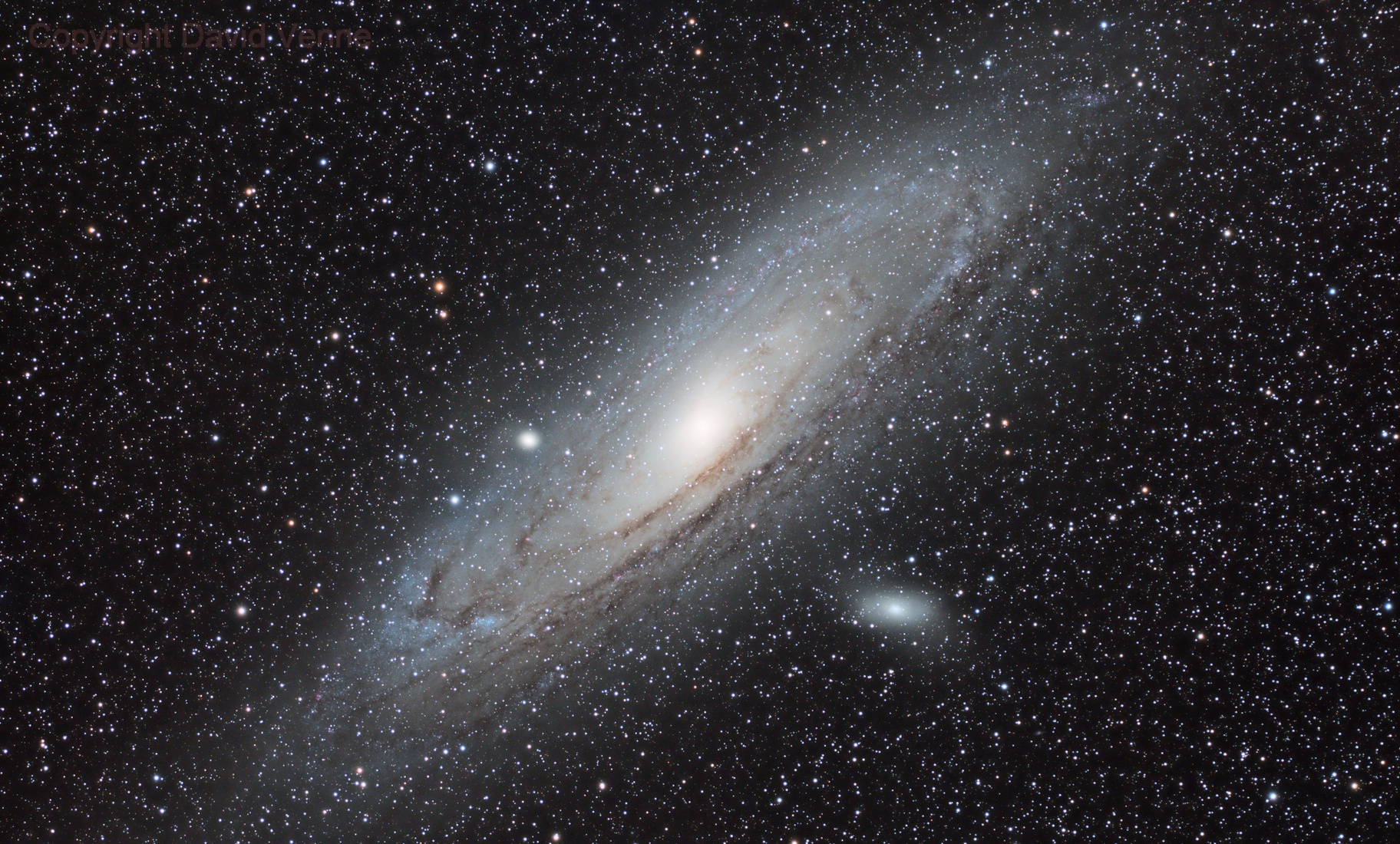
First is this completion of an earlier luminance-only image of M31:

The technical data and full scale image are here.

The colors in this may seem muted to you, but that's intentional. I much prefer less saturated images than  the common practice that I refer to as "color clipping" which results in super-saturation. See my other images from this year for other examples of softer hues, particularly the Cave and Gamma Cas nebula.

I am continually amazed by what the combination of autofocus and premium optics can achieve. Here is a full-scale portion of M31:

Hubble's Cepheid in M31

That unimpressive yellowish, fuzzy glow is a single star in another galaxy, in this case a rather historic star: Hubble's Cepheid Variable Star V1. Maybe I shouldn't be so excited about this, but I can't imagine resolving this with my old gear and manual focus. 

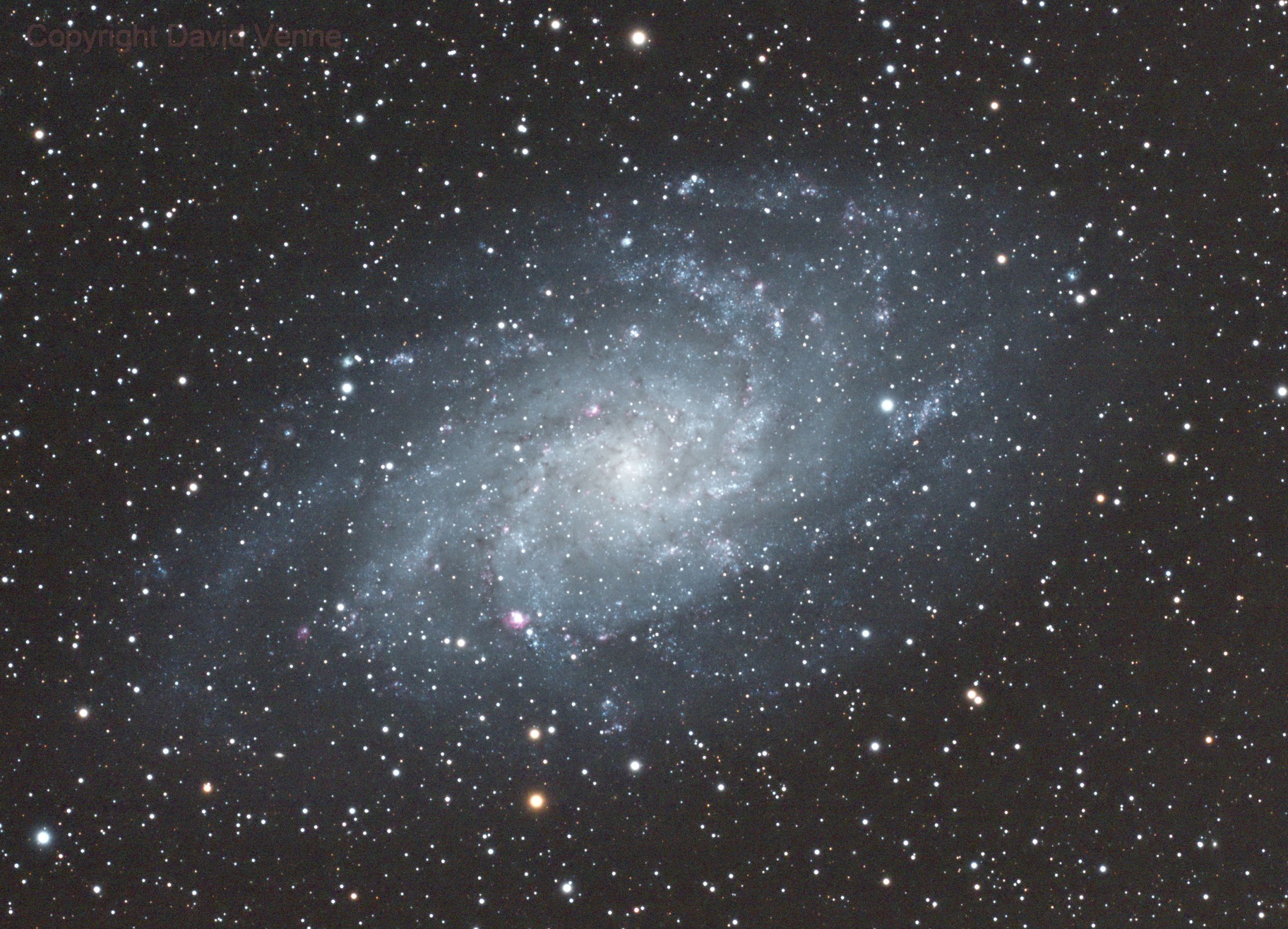
Next is one of those fortunate images a person makes while waiting for a primary target to rise. Here is M33, this time shot with the Takahashi CR 0.73 reducer.

Data and full image are here. Again note the more subtle coloration. I think the overall blue cast is "correct," but I've seen people produce M33 with colors all over the spectrum. 

Clouds ended the evening before my primary target rose high enough, so the California Nebula's RGB frames will need to wait for another night.

And No, I've not gotten back to the spectroscopic fun that I had hoped to. With winter on the doorstep it's unclear if I will.

Friday, September 16, 2022

Bumps on the imaging highway; more (unfinished) images

This is astrophotography, so things are never as easy as one hopes. 

At the beginning of September I had an all-night imaging session at the club's Eagle Lake Observatory site.  I was trying to do a few targets: M31, The California Nebula, and because a little time was left over as the dawn was approaching M42. Let's start with the latter because it illustrates the main issue.

I had only about a half an hour before the morning sky started to really brighten, so I set up NINA to do five 90-second frames for each LRGB channel. Here is the initial stretched result:

 
I did say LRGB, but this is mono! It turned out I took 20 L frames; the mystery is how that happened. I wish I could tell you, but I don't know the actual cause. My best guess is that NINA lost contact with the filter wheel and couldn't execute the filter changes. So this is not quite the image I wanted, but eventually I'll be able to shoot the chroma and make a nice image.
 
The same thing happened with my California Nebula frames and I've got 96 L frames which should make for a really nice eventual image. Here's a quick processing of the luminance frames:


This seems to have started as soon as I began imaging M31, as those are all (so far as I can tell) luminance frames. All 125 of them! I can say this from the early look at the M31 stack that if you want a very smooth background, shoot 125 frames! This is a first look at the luminance image, where I've somewhat de-emphasized field stars using PixInsight's Morphological Transformation:
 
 
Incidentally, these are all imaged using the Takahashi CR 0.73X focal reducer on my FSQ-106, so I was operating at  f/3.65 and an effective focal length of about 387mm.
 
Another mystery was easier to solve. I noticed that autofocusing was having a very difficult time. This was traced to a loosening of the connection between the motor and focuser shaft. I've tightened that up now, and just in case that was happening because of overly tight parking of the focuser I'm going to change the focuser's home position.
 
This weekend I hope to actually collect the M31 chrominance, and maybe deeper into September get the California Nebula color data.
 
-------------
 
I'm returning to something I started back in 2020: spectrographic imaging. More about that next time (I hope!)