Another star party, and continuing poor weather.
This was probably the hottest ISP ever.
Thursday: high temperature of 94F, dew point temperature of around 70F (heat index = 100F)
Friday: high temperature of 97F, dew point of 72F (heat index = 106F)
Saturday (the
nice day): 91F and 61F, (heat index = 91F)
Speaker's talk in the Barn: 86F and 66F (heat index = 88F) That was a very sticky 88!
Some relief was found at midday on Friday in the Oakridge house, but unfortunately the A/C unit was unable to keep pace with the heat: it actually froze up. I bailed out around 3 P.M., preferring to face the heat outside where the air occasionally moved.
Friday was also public night, and the attendance was significantly smaller than I recall from my last visit. Between the heat and the fact that it was the opening night of high school football, it's understandable if people decided to be elsewhere.
And how about the sky? Thursday night was grand, although around 1 A.M. the south wind began shoving clouds northward and the southern sky started to deteriorate. Friday night was great for the public, but about the time they left the clouds moved in. The sky went partly cloudy during the early morning, but at 4 when I woke up it was about 50% cloud cover. Visual observers could deal with that, but imagers not so much.
Saturday night usable sky was all of 90 minutes pinched between the end of twilight and clouds rushing southward ahead of thunderstorms. It never cleared for any substantial time after that, and in fact around 3 A.M. a thunderstorm with heavy rain and gusts to about 44 mph (at Carroll) hit us. From what I saw the next morning no one sustained serious damage from the winds, although a couple of screened sun shades looked like they needed some repair.
Yes, imaging time was scarce, but I managed to get three objects in. Thursday night started with M8 and surroundings:
 |
| Messier 8, the "Lagoon" |
Click this for a larger version. There are a number of objects here, not just the big old Lagoon. At lower left is globular NGC 6544. At about 10 O'clock from the lagoon and next to a bright double star is the pretty reflection nebula IC 5070. On the left edge of the picture about 1/5 of the way down from the upper left corner is emission/reflection nebula IC 4685. The lagoon itself is a confusing construct of NGC objects.
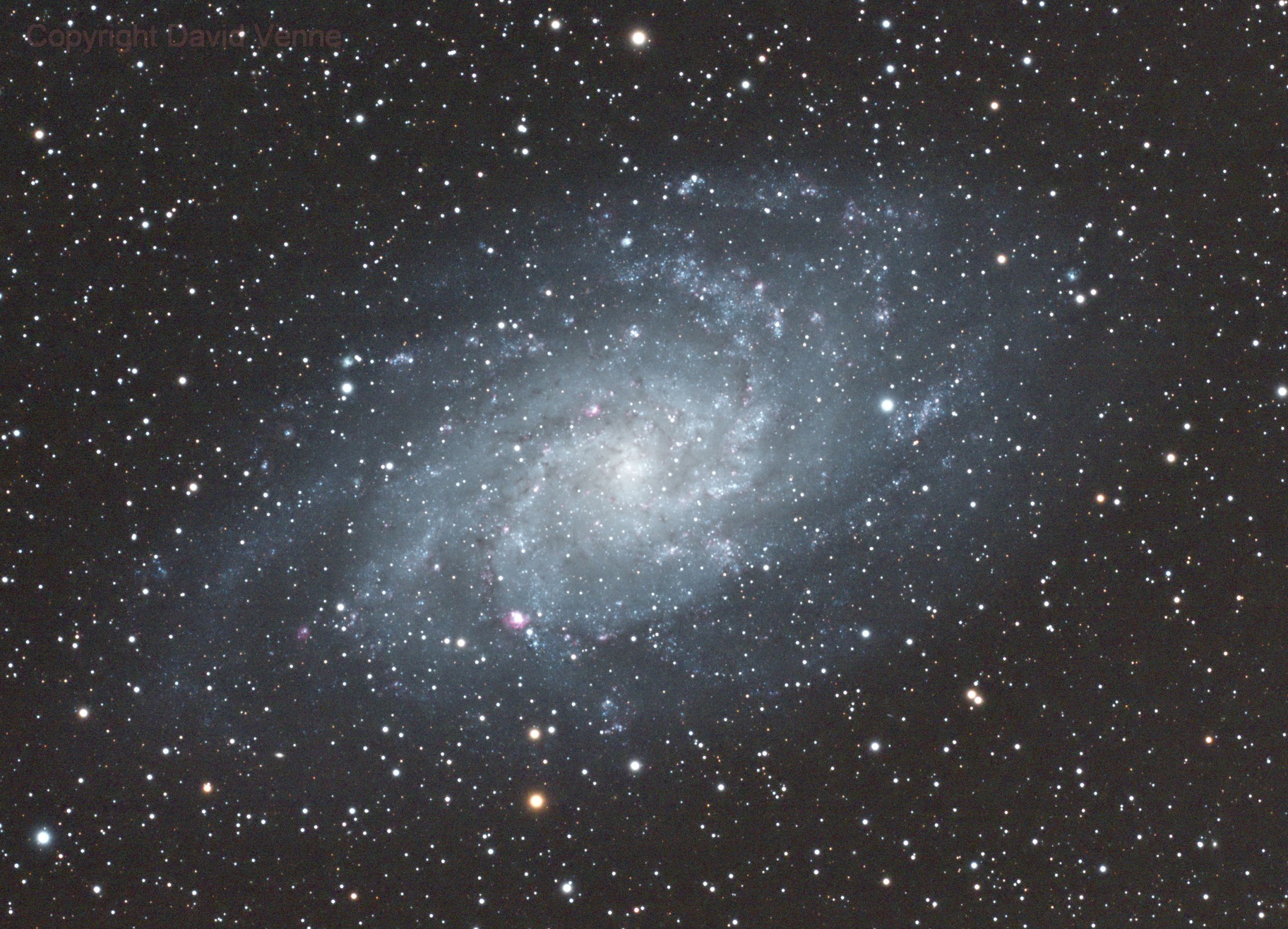
At this point it was a bit before midnight, and my sense was I didn't have much "awake" left in my tank. Some years ago at Jeffers I'd imaged M33 with my DSLR and TV102, so I thought I'd try it here with the AT72ED and CCD. Here's the result:
 |
| Messier 33, the "Pinwheel" |
The AT72 is really too short a scope for this object, but it was the scope at hand. I'm not happy with the color balance of this; judging by the star colors I'd almost say that the green channel is too strong. I'll doubtless reprocess this.
Friday night was clear for a while, and I was able to learn my target's star field while entertaining/educating the public. I think I collected one frame before having to shut down.
Saturday I raced from the meeting barn to the observing field and was able to get everything running and my target composed in under 30 minutes (a not-so-minor miracle). In fact, I even had to toss my first light frame because it was still twilight. about 90 something minutes later it was over. The NA and Pelican are bright!
 |
| Nebulae NGC 7000 "North America" (left) and IC 5070 "Pelican" (right) |
Don't know why the stars bloated so badly in this one. Poor focus, most likely. Clouds rolled in while there was still plenty of time for another image, so I count this as half a night.
Details for these images, along with their full-size versions can be found on
AstroBin.
---------------------------------------------------
The last year's star party log sheet runs like this:
HOASP (Autumn 2012): three nights of rain.
WOW: Registered but did not attend; I would have had one good night at best out of three.
Jeffers: 2 good nights out of 3.
South Dakota: 1 out of 3.
Iowa Star Party. 1.5 out of 3
Add those up and it was 5.5 good nights out of 15. Disappointing. Perhaps this autumn will be better? If it is, I'll probably be making more runs to the club's dark-sky sites. Stay tuned.