Friday, May 22, 2015

Five LBNs in one image

Last night everything worked correctly and I managed to image the cluster of LBNs in Serpens that includes LBN 8, 10, 11, 19, and 1122.

Here's the image:


These are NOT very bright. Only 1122 rises to the level of LBN brightness 4; 11 is brightness 5, and 8, 10, and 19 are all brightness 6. Which is to say that these are really quite dim. Despite 170m of luminance shot at f/4 aggressive stretching is needed to pick out the nebulae. Regardless of that, I consider these good enough to satisfy the Astronomical League.

These five lift my count to 92. Where will the final eight come from?

The remaining objects [and their brightnesses] within reach are clustered.

Cluster 1 Sh 2-12 [4], Sh 2-13 [?], and NGC 6357 [?]. These three fit into a 200mm lens field. Image during July.

Cluster 1: Sh 2-12, Sh 2-13, and NGC 6357 (Lobster)

Cluster 2 LBN 20 [4] and LBN 22 [5]. The AT65's field is perfect for this pair. Image during June or July.

Cluster 2: LBN 20 and LBN 22
(Cluster 3) LBN 70 [6], IC 4701 [4], and LBN 52 [2] fit into a 135mm lens field. LBN 70 is huge; it encloses the Eagle Nebula and LBN 68. July or August.

Cluster 3: LBN 70, IC 4701, and LBN 52
(Cluster 4) IC4812 [?] and NGC 6729 [?]. This pair also fits nicely into the AT65 FOV, although the TV-102 might be better. July.

Cluster 4: IC 4812 and NGC 6729
The four clusters contain ten objects, putting me two over the required 100. There are a couple of very dim objects that remain for August and September in the event that these fail, and if those fail it's back to winter imaging!


Saturday, May 16, 2015

Another Star Party Cloud-Out; Camera update

Today is the Saturday of the Two Rivers Spring Star Party and I'm posting this blog when I should be enjoying dark skies. The sad fact is that the entire run of the party has been filled with of clouds and rain and I've bailed out rather than sit in a tent for the remainder of the party.

AMENDED: The IR Satellite loop suggests that Saturday night is starting out clear. It won't stay that way, though; by midnight or 1 A.M. clouds will cover from the west. It still wouldn't have been a suitable night for my imaging.

A tale of woe: My last several parties are the Iowa Star Party (two out of two nights unsuitable), The Northern Nights Star Fest (three out of four cloudy/rainy nights) and now the TRSSP (three out of three cloudy/rainy nights). That gives me a whopping one night out of nine that I could see the stars.

The next star party is the Nebraska Star Party in July. Maybe I should ask them to pay me to stay away.


The T2i arrived sooner than expected! It's amazingly clean--it looks almost brand new, and more importantly looks to be 100% functional. I've communicated with Gary Honis about the modification, and he's got a slot open at the end of May. Maybe I'll have the modded camera back in time for the NSP? It could ride my CG-5 mount and do wide-field imaging while I'm using the CCD for other objects.

Monday, May 11, 2015

A New Camera

Last time I mentioned that I was considering purchasing a DSLR for imaging and had narrowed the field of candidate models to a short list.

The winner is the Canon T2i. I was able to pick one up on eBay for $183. (Here's hoping that it arrives in good shape and performs as well as the seller says it will.)

Here's how the T2i compares with the other candidates:

The 40D (introduced in 2007) has a sturdier build valued by professionals but lacks the video capability of the T2i that can be used for solar system imaging. The 40D is considerably larger and is 10.3 oz. heavier than the T2i; after imaging with the ST-8300M+FW8 tandem I'll appreciate the difference in weight and bulk. The T2i's pixel size is much smaller (4.3 vs. 5.7 m) making it a better match for my AT65 and TV-102. It's reported that the T2i's sensitivity is 2 f-stops better than the 40D.

The XSi (2008) is one model more recent than my XTi and has a large number of owners doing astrophotograpy. I suspect this is because it was the first consumer-class Canon camera with LiveView and USB one-cable operation. The XSi lacks video, and the T2i is said to be 3 f-stops more sensitive.

The T3i (2011) has slighter less noise than the T2i (2010), but it lost the crop mode video capability that helps with solar system imaging. The T3i adds the tilt-out display that's useful when the camera is used without a laptop but this feature is of little value to me. It also costs more to purchase being a year newer.

The T2i has a better display screen for focusing than either of the earlier models.

Assuming that the purchased camera checks out okay I'll be sending it off to Gary Honis for his Baader modification.


Two Rivers Spring Star Party Update--- It begins in three days and the weather forecast for the party is terrible: Every night mostly cloudy with a 40-50% chance of rain. Ugh.

Thursday, May 7, 2015

A More Diverse Imaging Capability

It's been cloudy, or clear with a waxing moon. So I've been working on small projects and considering a purchase.

The parallelogram binocular holder

 is coming along. This week completed all the work needed to completely assemble it. Amazingly it actually worked, providing the 11x80 binoculars with smooth freedom of motion. This morning I stained the pieces and tonight (or whenever the rain ends) I'll give it a nice coat or two of spar polyurethane.  No one is going to mistake it for the handiwork of a skilled wood worker, but it will work. And in the dark of night when it's used no one will notice the rough corners.

Remounting the Finder and Autoguider on my C925

The finder shoe on Celestron's C925 sits a little off-axis, making it more convenient to use. The small stock finder is so lightweight that the torque it produces is negligible. But the torque can become substantial when I configure the scope for imaging. For imaging I use a "Y" shaped mount that carries both a 9x50 finder and Orion MiniGuider. These throw the scope quite a bit off balance around the declination axis.

One solution would be to add a counterweight on the scope's opposite side, but it could be messy trying to figure out how much weight should go where.

A better solution was made possible by a dovetail bar installed on the scope by its previous owner. The bar extends from front to back and is made of stout ADM manufacture; it works great as a sort of handle for lifting the scope.

It was short work to drill a couple of holes in the bar, tap threads into them, and fasten a spare Vixen-style finder shoe I happened to have. This shoe has a flat base and fits perfectly onto the bar. Now the finder/guider tandem sits exactly opposite the scope's base and the torque should be gone.

Now the purchase: Adding Imaging Flexibility

I'm seriously considering adding a DSLR for imaging. This isn't intended as a replacement for my ST-8300M, which gives me the ability to do narrowband imaging from my back yard.

Perhaps this is a case of gear envy brought on by lousy weather. Maybe it's just me getting a little tired of having to shoot flat frames for every channel when I do LRGB. Maybe it's just an itch caused by some unexpected funds coming from the closing of my software business. In any event, I've been investigating used DSLRs.

Let's start with a price point of $600 maximum for a modded camera body. Preferred would something under $400. Under $300 would be great! And because I'm somewhat invested in Canon lenses, I'll consider only a Canon body.

Models being considered are the 40D, XSi, 50D, T1i, T2i and T3i. I've seen and handled the 40D; it's a nice camera, better built to resist the elements than the XSi is. The 50D is said to be a step up from the 40D; of the three Tn cameras the T2 stands out because of its crop mode video capability which makes it suitable for solar system imaging.


Sunday, April 19, 2015

Two Rivers Spring Star Party: Image Planning

Sometimes planning seems like an exercise in futility, but it can be helpful when preparing to image far from home.

My first 2015 star party trip is to the Two Rivers Spring Star Party at the May new moon. This is located a little north of Barry, IL on a private farm. There's no power except for recharging batteries, so I'll be running from my big batteries all three nights.

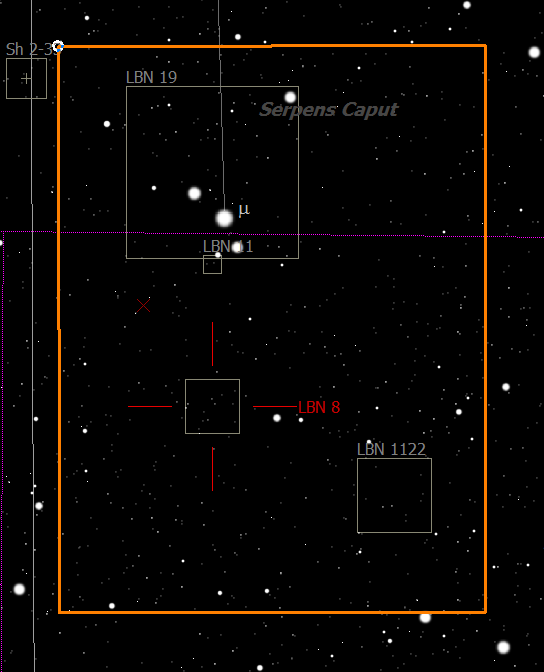
What's to image? There's a cluster of five ALBN objects to go after. Fitting neatly into a 135mm field are LBNs 8, 10, 11, 19, and 1122. All are emission nebulae. 1122 is a brightness four, 11 a five, and the rest sixes. This is an all-night group, complete with a meridian flip around 2 A.M. if the four hours from 10 to 2 aren't adequate. This should make a nice LRGB image!

LBN 10 is located at the red "X" NE of LBN 8and is about the same size as LBN 1122
Assuming there's a second clear night, I'll go after something not possible from Minnesota. LBN 1091 transits at 12:49 at an altitude of almost 16 degrees. This has an LBN brightness of 6, so it's going to be difficult if not impossible.

The rest of the ALBN objects I have to do are better imaged later in the summer. If there's a third night of clear sky I'll do a pretty picture. Maybe an LRGB of the Antares area at 135mm. What're the chances of that?

Thursday, April 16, 2015

M51

I changed my imaging plans (as I often do) and imaged M5 instead of M82. I'd have more time on target that way. As it ended up, I had 105m unbinned L, and 40m binned 2x2 of R, G, and B. These were about the longest I wanted to go with the C925 operating at f/10.

I'm still having issues with the image--the sensor plane is not perpendicular to the optical axis. Possibly this happened at the coupling, or potentially much worse is an issue with the secondary mirror. Coma-like stars aside the big issue was the sky brightness. Once again the limiting magnitude was awful, something like 3.5.


Another ongoing issue is the poor showing of blue and the color balance in general.(Note the pink star at left and the blue-green one to the right.) I'm going to be a bit of a purist and suggest that many imagers oversaturate M51 to make the arms a vibrant blue. Something between what they do and what you see above would be more to my taste.

This weekend I hope to return to ALBN imaging, but as the day has progressed the weather forecast has deteriorated. If it clouds out I'll have a chance to clean my optics and work on my binocular holder. Almost time to send in my registration for the Two Rivers Spring Star Party!

Sunday, April 12, 2015

Last Night Could Have Gone Better

Some nights are great. All the hardware works just like it's supposed to, the weather cooperates, and you end up with a fine image. Then there are nights like last night.

How it went:

Finder and C925 axes aligned using Venus. No problem.

Polaris was still visible through the leafless tree branches (it won't be in a couple of weeks) and I could use my polar scope to get me approximately aligned. Then I fired up PHD2 and that got me a much better alignment.

Now which to image first? Dwarf planet Orcus or dwarf galaxy Leo I? Fire up Sky Tools and figure it out. But wait, Orcus isn't in the list of Dwarf planets like it is on my desktop PC. Fix: Download the data. No: WiFi signal is too weak in the back yard. Bring Laptop inside, still won't connect. Seems it has forgotten the network password, as have I. Look up PW, get laptop on the Internet. Download dwarf planet observing list. Still no Orcus. Go through Supplemental data area for the update, still no luck.

Create a SkyTools synch backup from my desktop, which takes almost five minutes for some reason. Load the synch onto the laptop, and there's Orcus. Go back outside.

Decide that Leo I is first. Navigate to Regulus. Begin to refine focus. Whoa: Stars are way out of round and any sort of reasonable focus is impossible. Obviously the C925 needs collimation. Mine came with Bob's Knobs from its previous owner, so I tweak one of the knobs and hope for the best. This initially makes it much worse, but eventually I walk it back to as bad as it was.

I begin to wonder if this is a problem with the focal reducer. I remove that from the optical path and try focusing again. No improvement, and now I've got an even smaller field of view to work with.

More playing with Bob's Knobs to no avail. I discover that the secondary's lock ring is loose and that the secondary can be spun around. Really not good.

At this point it dawns on me that there won't be any imaging. In desperation I get Leo I composed and shoot a 300s light frame binned 2x2. All I get is an overexposed field full of really horrible looking stars. The sky is too bright?

Yes, it is. I shoot another frame unbinned and get a better background. But where the dwarf galaxy is supposed to be is only darkness, even after the usual stretching. The sky is simply too bright.

So Leo I is off because of collimation and sky brightness, and Orcus can be forgotten because of the poor alignment. Evening over.

Imaging can be fun, but not when one doesn't pay attention to details.

One other detail I let slide was on the satellite loop. During the late afternoon it was obvious that what looked like a wide layer of smoke was moving northward out of Iowa and Missouri. I've seen smoke obliterate the view at a dark site, and over the light dome of the city it lit up to make imaging difficult if not impossible. My backyard limiting magnitude is typically 4 to 4.5; last night I estimated it to be around 3.0.

Tonight I collimated my C925 using the Hubble artificial star light, a really slick little LED flashlight with a precisely drilled mask. I also read up on the process of collimation at Starizona. Interesting to me was what Starizona said about Bob's Knobs:

In our experience, the original screws on an SCT secondary mirror are much better to use for collimation purposes than the aftermarket thumbscrews that can be added.  Thumbscrews cannot be turned as precisely, making accurate alignment difficult.  Also, thumbscrews do not hold the mirror as tightly, increasing the need to collimate more often.  Thumbscrews also tend to make people "collimation happy," tending to collimate a scope far more often than necessary.  Under normal use, you should be able to go months without collimating a telescope.

I removed the Knobs, snugged the locking ring, and collimated just fine. I have nothing against the product, but I can definitely relate to the idea of them tempting someone into being "collimation happy." I think I achieved "collimation loony" last night.

The weather service AND the CSC says that tomorrow night will be gloriously clear here, so I'll try again.

Maybe things will go a little better?